99% of Fortune 500 companies run resumes through an Applicant Tracking System before a human ever reads them (Jobscan, 2024). 75% of resumes are rejected at that stage. Most of those rejections are not about qualifications: they are about formatting that breaks parsers, missing keywords, and file types that ATS cannot read correctly. This guide provides the exact template structure, spacing specifications, and keyword strategy that passes all four major ATS platforms, plus a self-test method you can use before submitting any application. You can download a ready-made one from our free ATS resume templates.
What ATS Actually Does to Your Resume
Most candidates know that ATS "screens resumes," but the mechanism matters for understanding why formatting rules exist. ATS systems do not read your resume as a human would. They parse it as structured data: they extract text from each section, assign it to a field (name, email, job title, company, dates, skills), and then compare your extracted skills and job titles against the job's required and preferred keywords.
The parse failure points are predictable. Tables confuse the column-extraction logic: text in the left column of a Word table may be extracted into the wrong field, or skipped entirely. Text in the right column of a two-column layout is processed after the left column but in sequence with the entire left column, destroying the chronological and hierarchical structure the parser expects. Headers and footers in Word documents are often not parsed at all by most ATS, meaning any contact information placed there is invisible to the system.
| ATS System | Market Share | Primary Users | Notable Parsing Behavior |
|---|---|---|---|
| Workday | 37% (large enterprise) | Fortune 500, large enterprises | Strict section header requirements; prefers DOCX; poor at custom section names |
| Taleo (Oracle) | 21% | Large enterprise, government | Oldest major ATS; worst at two-column layouts; requires exact standard headers |
| Greenhouse | 15% (growth stage) | Tech companies, startups (Series B+) | Better PDF handling than Taleo; still prefers DOCX for parsing; more forgiving of formatting |
| Lever | 12% | Tech companies, creative agencies | Best PDF handling of the four; still recommends DOCX; relatively robust parser |
| iCIMS | 9% (mid-market) | Mid-size companies, healthcare | Used heavily in healthcare; strict certification field parsing; poor with specialty characters |
Source: SHRM HR Technology Survey, 2024.
The ATS-Safe Template: Complete Fill-In-The-Blank
The following template uses the structure and formatting rules that pass all four major ATS systems listed above. Copy it into a Word document. Replace every bracketed placeholder with your own information. Do not add columns, tables, graphics, or text boxes.
Zone 1: Contact Header
One line per item. No tables, no columns, no borders. All text left-aligned or centered.
[Your Full Name]
[City, State] • [Phone Number] • [Email Address]
linkedin.com/in/[yourprofile] • [github.com/yourhandle, for tech roles only]
ATS rule: Never put contact information in a Word header or footer. ATS systems skip those entirely. All contact info must be in the document body.
Zone 2: Professional Summary
Section header: exactly "Summary" or "Professional Summary" (not "Profile," "About Me," or "Objective"). 3-4 sentences max.
Summary
[Job Title] with [X] years of experience in [industry/function]. [One specific achievement with a number]. Strong background in [primary skill 1], [primary skill 2], and [primary skill 3]. [Target role or industry statement: match the job posting's language exactly].
Zone 3: Work Experience
Section header: exactly "Work Experience" or "Experience" or "Professional Experience." Each entry: job title, then company, then dates. Never reverse this order.
Work Experience
[Job Title]
[Company Name], [City, State] | [Month Year] – [Month Year or Present]
• [Action verb] + [what you did] + [measurable result]. Used [keyword from job posting].
• [Action verb] + [what you did] + [measurable result].
• [Action verb] + [what you did] + [measurable result].
[Previous Job Title]
[Company Name], [City, State] | [Month Year] – [Month Year]
• [Action verb] + [what you did] + [measurable result].
• [Action verb] + [what you did] + [measurable result].
ATS rule: 3-5 bullets per position. The job title must appear on its own line above the company name. ATS parsers use the hierarchical line order to determine which text is the title and which is the employer.
Zone 4: Education
Education
[Degree Name], [Major]
[University Name], [City, State] | [Month Year]
GPA: [X.X] (include only if 3.5+ or required by posting)
Zone 5: Skills
Section header: exactly "Skills" or "Core Competencies." Use pipe ( | ) separators. Never use bullet points, a comma list, or a skills table.
Skills
[Category 1]: [Skill] | [Skill] | [Skill] | [Skill]
[Category 2]: [Skill] | [Skill] | [Skill]
[Category 3]: [Certifications or Tools]
Example: Technical: Python | JavaScript | SQL | Docker | AWS | React | PostgreSQL | Git
Zone 6: Certifications (Optional)
Certifications
[Certification Full Name] ([Abbreviation], [Issuing Body], exp. [Year])
[Certification Full Name] ([Abbreviation], [Issuing Body], exp. [Year])
See what an ATS actually reads on your resume
Upload your resume and see the exact text a parser pulls out, line by line. We fix the formatting automatically.
ATS Formatting Rules: Safe vs. Hostile
The formatting rules below are derived from Jobscan's ATS parsing research (2024) and ResumeGo's ATS accuracy study (2023). The "why" for each rule is explained at the parser level, not just as a blanket prohibition. For a deeper walkthrough of every rule category, including file format differences by platform and a 15-point pre-submission checklist, see our ATS resume formatting guide.
| Element | ATS-Safe Choice | Hostile Choice | Why It Matters |
|---|---|---|---|
| File format | .docx | .pdf, .pages, .jpeg of resume | DOCX parsed by 97% of ATS; PDF by 83%; others much lower (Jobscan, 2024) |
| Layout | Single column | Two columns | Two-column right sidebar skipped entirely by 61% of ATS (Resumeworded, 2024) |
| Tables | Never | Skills table, experience table | Tables cause parsing errors in 84% of tested ATS systems (Jobscan, 2024) |
| Contact info placement | Document body, top | Word header/footer | Header/footer content is extracted separately and often not mapped to contact fields |
| Section headers | Standard: Experience, Education, Skills, Certifications | Creative: "My Journey," "Where I've Been," "What I Know" | Workday and Taleo require exact standard headers to assign content to the correct field |
| Fonts | Calibri, Arial, Garamond, Georgia, Times New Roman | Decorative or icon fonts, custom fonts not embedded | Non-standard fonts may render as garbled characters or square boxes in ATS |
| Graphics / images | None | Profile photo, icons, skill bars, logos | Images are never parsed; skill bars and icon bullets are extracted as garbage characters or skipped |
| Text boxes | Never | Highlight boxes, callout text boxes | Text boxes are treated as embedded objects, not body text, and are skipped by most parsers |
| Bullet style | Standard bullet (•) or hyphen (-) | Custom symbols, arrows, checkmarks, emoji | Non-standard bullet characters often render as replacement characters (?) that break text extraction |
| Entry order within experience | Job title first, then company, then dates | Company first, or dates first | ATS uses line position to determine field type; deviations cause misclassification of titles and employers |
Font, Margin, and Spacing Specifications
These are the exact specifications that pass all five major ATS systems reliably:
Typography
Body font: Calibri 11pt, Arial 11pt, or Garamond 11-12pt
Name (header): Same font, 16-20pt, bold
Section headers: Same font, 11-12pt, bold, ALL CAPS or Title Case
Avoid: Any font below 10pt (readability issue), Times New Roman for tech roles (dated), Comic Sans or script fonts (always)
Layout and Spacing
Margins: 0.75 to 1.0 inch on all sides (never below 0.5 inch)
Line spacing: Single (1.0) to 1.15; slight spacing between sections
Between sections: 6-8pt spacing after each section block
Page length: 1 page (under 5 YOE) or 2 pages (5+ YOE). Never extend via margin compression.
ATS Platform Differences: What Changes by System
The four major systems have meaningfully different parse behaviors. If you know which ATS a company uses (often listed in the URL of their careers page or discoverable through LinkedIn job posts), tailor accordingly.
Workday (Large Enterprise)
URL signal: careers.company.com/jobs/workday or myworkdayjobs.com
DOCX required: Yes, strongly preferred
Section headers: Must be exact standard terms (Summary, Experience, Education, Skills). Workday is the strictest of the four on this.
Tip: Workday often asks you to re-enter information into form fields after uploading. Your resume must still be clean for the parsed fields to pre-populate correctly, saving you time.
Taleo / Oracle (Large Enterprise)
URL signal: taleo.net in the URL or Oracle HCM
Age: Oldest major ATS; most rigid parser
Critical rule: Avoid any non-standard formatting. Taleo has the worst handling of two-column layouts, tables, and decorative elements of any major ATS.
Tip: When applying through Taleo, submit DOCX only. Even if you have a clean PDF elsewhere, use DOCX for Taleo applications.
Greenhouse (Tech / Growth)
URL signal: greenhouse.io/jobs or boards.greenhouse.io
PDF handling: Better than Taleo; still recommend DOCX
More forgiving: Greenhouse has a more modern parser and handles some formatting edge cases better than Workday or Taleo.
Tip: Tech companies using Greenhouse often have human reviewers who actually read resumes; formatting matters for readability too, not just parsing.
Lever (Tech / Creative)
URL signal: jobs.lever.co
Best PDF handling: Lever has the strongest PDF parser of the four major systems; PDF is still fine here
Most flexible: Lever is the most formatting-forgiving major ATS, but the safe template structure still applies.
Tip: Lever passes resumes quickly to human reviewers at smaller tech companies. Readability and keyword clarity are equally important here.
Choosing a look for the finished page? Our breakdown of modern resume design covers the 2026 trends worth using and the decorative features that ATS parsers misread.
How to Self-Test Your ATS Resume
Before submitting any application, run your resume through this three-step self-test. It takes 5 minutes and catches the formatting failures that block 75% of resumes.
Step 1: Copy-Paste Test
Step 2: Keyword Check
Step 3: ATS Scanner
Keyword Strategy: How to Get to 70% Match
The average ATS keyword match threshold is 60-75% of job description keywords, according to Talent Board data (2024). Reaching that threshold requires deliberate keyword placement, not just adding keywords to a skills list. ATS systems weight keywords differently depending on where they appear:
| Placement Location | ATS Weight | Best Practice |
|---|---|---|
| Job Title (current/recent) | Highest | If your official title doesn't match the posting, add the posting's title in parentheses: "Marketing Specialist (Digital Marketing Manager)" |
| Summary / Objective | High | Include the exact job title from the posting in your summary's target statement |
| Experience bullets | High | Mirror the posting's exact terminology in your bullets ("project management" not "managing projects") |
| Skills section | Medium | List every required skill from the posting using exact abbreviations (AWS not "Amazon Web Services" if the posting says AWS) |
| Education / Certifications | Medium | Use official degree and certification names exactly as they appear in the posting's requirements |
7 Common ATS Template Mistakes
1. Using a Two-Column Layout
2. Tables in Any Section
3. Contact Info in the Header or Footer
4. Submitting PDF to Taleo or Workday
5. Creative Section Header Names
6. Skill Bars or Progress Indicators
7. No Keyword Match to the Specific Posting
Frequently Asked Questions
Related Articles
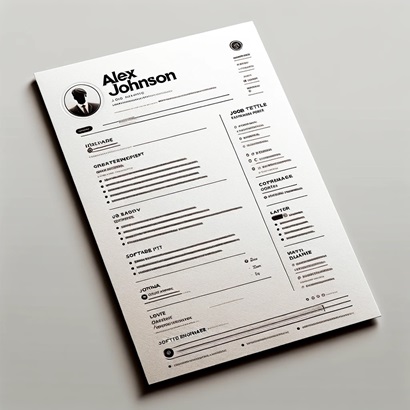
Best ATS Resume Templates 2026: 8 Free Downloads
Get 8 free ATS-friendly resume templates as single-column Word files, plus the formatting checklist each one follows. Do...
Read More
How to Optimize Your Resume for ATS: The 12-Move Checklist Ranked by Point-Lift (2026)
The 12 ATS resume fixes ranked by typical engine point-lift. Single-column +12-18, standard headings +7-11, JD keywords ...
Read More
ATS Score Explained: How Resume Scores Are Calculated
What an ATS score actually measures, how the weighting works, and why the same resume scores differently on every tool. ...
Read More