An artist CV is not a resume. It follows a different structure, has no page limit, and is organized by credential category rather than by employer. Whether you are applying to a gallery, submitting to a residency program, or interviewing for an MFA teaching position, the format, section order, and level of detail in your CV signals how seriously you take your practice. This guide walks through every section using the College Art Association (CAA) standard, with two fully filled examples and a clear breakdown of when an applicant-tracking system actually touches your document.
Artist CV vs. Artist Resume: Which One Do You Need?
The terms "artist CV" and "artist resume" are often used interchangeably, but they describe different documents with different purposes. Knowing which one a submission requires will keep your application from being disqualified before a curator reads a single line.
| Document | Length | Used For | Page Limit |
|---|---|---|---|
| Artist CV | 2–10+ pages | Academic positions, MFA program applications, museum grants, major residencies | None (grow with career) |
| Artist Resume | 1–4 pages | Gallery open calls, smaller residency programs, grant proposals, commissions | Usually 3 pages max |
The College Art Association recommends the full CV format for academic and institutional contexts and a condensed version for gallery and residency submissions. When an open call specifies "CV or resume," read the word count or page limit guidance in the application instructions. If none is given, a 3-page condensed CV is a safe default for residency submissions, according to the Format.com 2026 residency guide.
An artist CV is also distinct from an artist statement. Your statement is a first-person prose essay (typically 150 to 300 words) explaining your conceptual practice, working process, and artistic interests. It is a separate document submitted alongside the CV, never embedded within it.
Quick Rule
If the application asks for a CV, submit a comprehensive document with every credential. If it asks for a resume or lists a page limit (such as 3 pages), submit a condensed version. Never combine the artist statement with the CV in the same file unless the application explicitly instructs you to do so.
Artist CV Format Rules
The CAA Visual Artist CV Guidelines specify a clean, readable layout above all else. Decorative fonts, colored text, artwork thumbnails embedded in the CV, and headshots all work against you in a gallery or committee review context. The following rules apply regardless of career stage.
Typography
- Font size: 10 to 12 point (CAA standard)
- Acceptable fonts: Arial, Helvetica, Times New Roman, Palatino
- No colored type, no decorative display fonts
- Section headers may be bold or slightly larger (12 to 14pt max)
Layout
- Single-column layout preferred
- No artwork images or photos embedded
- No colored paper or colored background areas
- Standard margins: 0.75 to 1 inch
The full artist CV has no page limit. Emerging artists typically fill 1 to 2 pages; mid-career artists average 3 to 5 pages; established artists with decades of exhibition history may reach 10 pages or more. The CAA formal standard recommends 2 to 4 pages for most working artists. Do not pad a short CV with personal projects or private commissions to reach a minimum length.
Submit as a PDF. Most galleries and residency programs will not open a Word document, and .docx files can reformat unpredictably. Name the file clearly: LastName_FirstName_CV_2026.pdf.
Section Order for a Visual Artist CV
The CAA recommends a specific section order, with the exhibition record placed prominently because it is the primary measure of a visual artist's professional standing. The order below applies to an established or mid-career artist. Emerging artists may reorder to lead with education when exhibition history is limited.
- Name and Contact Information (name, city/state, email, website, social media if professionally active)
- Education (reverse chronological, degree, institution, year)
- Solo Exhibitions
- Two-Person or Duo Exhibitions (if applicable)
- Group Exhibitions
- Residencies
- Awards and Grants
- Collections (public institutions listed first, then private)
- Bibliography and Press (publications about your work, interviews, catalog essays)
- Teaching and Curatorial Experience (if relevant to the application)
- Gallery Representation
Every entry within each section follows reverse chronological order, meaning the most recent year appears first. This is the CAA standard and the one curators and committees expect. Do not group exhibitions by type within the same year; always order by year descending.
Education Section
List degrees in reverse chronological order. Include the degree type, institution name, city, state (or country for international institutions), and graduation year. If you completed coursework toward a degree but did not finish, do not list it. Studio practice certificates and workshops are listed under a separate "Professional Development" section if included at all.
Education — Correct Format
MFA, Studio Art, Yale School of Art, New Haven, CT, 2019
BFA, Painting, Rhode Island School of Design, Providence, RI, 2016
For MFA program applications specifically, education is often the most scrutinized section after the portfolio. List your undergraduate institution even if it is less prominent than your graduate institution. Thesis title and committee members may be included for academic position applications where they are relevant.
Exhibitions Section: The Most Important Part of Your CV
The CAA identifies the exhibition record as the primary credential for a visual artist. Committees and gallerists read this section first. Format each entry consistently: exhibition title (italicized), gallery or venue name, city, state or country, year. For major museum exhibitions, include the curator's name in parentheses.
Solo Exhibitions
Threshold, Sargent's Daughters, New York, NY, 2025
Interior Logic, NOMA Gallery, New Orleans, LA, 2023
Group Exhibitions
New American Voices, Museum of Contemporary Art Denver, Denver, CO, 2024 (curated by Nora Aguilar)
Surface Tensions, Volta NY, New York, NY, 2023
Open Call: Abstraction, Smack Mellon, Brooklyn, NY, 2022
Keep solo exhibitions and group exhibitions in separate sections. Never merge them. A two-person show is distinct from both and should appear in its own "Two-Person Exhibitions" section if you have more than one. Juried exhibitions belong in group exhibitions; label them "(juried)" at the end of the entry if the distinction matters for the application context.
Listing Online and Virtual Exhibitions (Post-2020)
Virtual exhibitions gained legitimacy during 2020 through 2022 and are now accepted on a CV when hosted by a credible institution. Format them the same as physical exhibitions, adding "(online)" after the venue name. Do not list Instagram features, personal website exhibitions, or self-organized online shows.
Distributed Futures, Rhizome (online), New York, NY, 2021
Listing NFT and Digital-Native Work
NFT sales and platform-native digital work are listed under a separate "Digital Editions" or "NFT Releases" section, not under exhibitions. Format: edition title, platform name, year. Only include editions that sold or were curated by a recognized platform (Art Blocks, Foundation, SuperRare). Do not list unsold minted works.
Residencies, Awards, and Grants
Residencies are listed in reverse chronological order with program name, location, and year. Awards and grants follow the same format. List the granting organization, award name, and year. Do not list applications that were not selected.
Residencies
Skowhegan School of Painting and Sculpture, Madison, ME, 2024
MacDowell Colony, Peterborough, NH, 2022
MASS MoCA Assets for Artists, North Adams, MA, 2021
Awards and Grants
New York Foundation for the Arts (NYFA) Fellowship, Painting, 2025
Joan Mitchell Foundation Grant, 2023
Pollock-Krasner Foundation Grant, 2021
Residency programs vary in prestige and duration. A summer intensive at a recognized program (Skowhegan, MASS MoCA, Studio Museum in Harlem) carries significant weight. Shorter community residencies are worth including early in a career but can be removed as the CV grows. The Studio Museum in Harlem requires applicants to submit a CV plus an artist statement as a PDF, reflecting the standard format for competitive residency submissions.
Collections Section
The collections section lists institutional or private collections that have acquired your work. Public institutional collections appear first (museums, universities, government collections), followed by private collections. Private collectors are typically listed as "Private Collection, City, State" to protect their privacy unless they have given explicit permission to be named.
Collections
Brooklyn Museum, Brooklyn, NY
Hammer Museum, Los Angeles, CA
Colby College Museum of Art, Waterville, ME
Private Collection, New York, NY
Private Collection, London, UK
Do not include works sold through open markets (art fairs, online platforms) unless the buyer was a named institution. Corporate collections (a company's office art program) may be listed by company name if the collection is formally maintained and documented.
Publications and Press Section
The bibliography and press section covers all published writing about your work. Format entries consistently using a standard citation style (MLA or similar). List catalog essays, reviews, artist interviews, and monographs. You may subdivide this section into "Catalogs and Books," "Periodicals," and "Online Press" if the list is long.
Bibliography and Press
Chen, Marcus. "Painting the Threshold." Artforum, vol. 63, no. 4, 2025, p. 88.
Reyes, Sofia. "Studio Visit: Elena Vasquez." Art in America, March 2024.
Interior Logic. Exhibition catalog. NOMA Gallery, 2023.
Park, James. "Ten Artists to Watch." Hyperallergic, January 15, 2023.
Do not list reviews you wrote yourself, artist talks you gave (those belong under "Lectures and Panels"), or press mentions that only list your name without substantive coverage of your work.
Emerging Artist CV: What to Include When You Have Limited Exhibition History
An emerging artist CV with only two or three shows does not need to be padded or apologized for. The structure is the same. You lead with education, include every credible group exhibition (including well-regarded student shows and juried competitions), and list any residency experience, even short summer programs. Below is a realistic filled example for an emerging artist two years out of an MFA program.
Emerging Artist CV Example: Jordan Ellis
Jordan Ellis
Brooklyn, NY | jordan@jordanellisart.com | jordanellisart.com
EDUCATION
MFA, Studio Art (Painting), Hunter College, City University of New York, New York, NY, 2024
BFA, Fine Arts, University of Michigan, Ann Arbor, MI, 2021
GROUP EXHIBITIONS
Graduate Thesis Exhibition, Bertha and Karl Leubsdorf Art Gallery, New York, NY, 2024
Emergent Forms, Westbeth Gallery, New York, NY, 2024
Open Studios, Flux Factory, Queens, NY, 2023
Senior Exhibition, Stamps School of Art and Design, Ann Arbor, MI, 2021
RESIDENCIES
Flux Factory Open Residency, Queens, NY, 2023
AWARDS AND GRANTS
Hunter College Graduate Award in Studio Art, 2024
TEACHING
Teaching Assistant, Foundations of Painting, Hunter College, New York, NY, 2022–2024
Compare this with the following established artist snapshot. The structure is identical; only the volume of entries differs.
Established Artist CV Snapshot: Elena Vasquez (selected sections)
Elena Vasquez
New York, NY | studio@elenavasquez.com | elenavasquez.com
EDUCATION
MFA, Painting, Yale School of Art, New Haven, CT, 2007
BFA, Studio Art, School of the Art Institute of Chicago, Chicago, IL, 2004
SOLO EXHIBITIONS (selected)
Threshold, Sargent's Daughters, New York, NY, 2025
Interior Logic, NOMA Gallery, New Orleans, LA, 2023
Quiet Fields, Lisa Cooley Gallery, New York, NY, 2021
Residue, Patel Brown Gallery, Toronto, ON, 2019
First Contact, NOMA Gallery, New Orleans, LA, 2016
SELECTED GROUP EXHIBITIONS
New American Voices, Museum of Contemporary Art Denver, Denver, CO, 2024 (curated by Nora Aguilar)
Surface Tensions, Volta NY, New York, NY, 2023
Painting Now, ICA Philadelphia, Philadelphia, PA, 2022
RESIDENCIES
Skowhegan School of Painting and Sculpture, Madison, ME, 2024
MacDowell Colony, Peterborough, NH, 2013
AWARDS AND GRANTS
New York Foundation for the Arts (NYFA) Fellowship, Painting, 2025
Joan Mitchell Foundation Grant, 2023
Pollock-Krasner Foundation Grant, 2021
COLLECTIONS
Brooklyn Museum, Brooklyn, NY
Hammer Museum, Los Angeles, CA
Private Collection, New York, NY
Private Collection, London, UK
BIBLIOGRAPHY (selected)
Chen, Marcus. "Painting the Threshold." Artforum, vol. 63, no. 4, 2025, p. 88.
Reyes, Sofia. "Studio Visit: Elena Vasquez." Art in America, March 2024.
Emerging Artist: What to Include
- All graduate and undergraduate shows
- Juried competitions (label them "juried")
- Short-term and open studio residencies
- Teaching assistant or workshop facilitation roles
- Any publications, even student journals
- Academic awards and department grants
What to Leave Off (All Career Stages)
- Instagram features or social media highlights
- Self-organized shows in your own studio
- Gallery openings you attended but did not exhibit in
- Work experience unrelated to art (unless academic role)
- Artwork images or photos of yourself
- Unsold or uncurated NFT mints
When ATS Matters for Artists (and When It Does Not)
Most artists assume their CV is always read by a human. That is true for gallery submissions and many residency programs. But the picture is more nuanced for academic positions, and understanding the difference can save your application.
| Submission Type | Platform | ATS Involved? | What This Means for Your CV |
|---|---|---|---|
| Gallery open call | Email PDF, CaFE (callforentry.org) | No | Human reads PDF directly; formatting and layout matter aesthetically |
| Residency application | SlideRoom, Submittable | No (semi-structured forms, not ATS) | These platforms collect structured fields; your CV uploads as a PDF attachment read by humans |
| Academic art position (studio art professor, MFA faculty) | Interfolio, Workday Academic, HigherEdJobs | Yes | CV text is parsed; use single-column layout, no text boxes, no decorative fonts, standard section headers |
| MFA program application (as student) | SlideRoom, Submittable, school portals | No | Admissions committee reviews your PDF; formatting is a signal of professionalism |
SlideRoom and Submittable are the two dominant digital application platforms for artist residencies, based on observed 2026 open calls listed at Colossal, Spudnik Press, and the Alberta Society of Artists. Both platforms collect images separately from the CV upload. They are not ATS systems: no keyword scanning or resume parsing occurs. Your CV is delivered as a PDF to the review committee.
Academic positions are a different case. Institutions using Interfolio (the dominant platform for tenure-track studio art faculty positions) or Workday Academic do process your CV through standard parsing logic. For these applications, maintain a separate "academic CV" version formatted in a clean single-column layout with standard section headers. Avoid text boxes, tables, and any layout elements that could confuse a parser.
Academic Position Checklist (ATS-Ready Artist CV)
- Single-column layout with no text boxes or multi-column grids
- Section headers as plain text (bold is fine; graphics are not)
- Consistent date formatting throughout (year only, or Month Year)
- No artwork images embedded in the document
- File saved as a text-layer PDF (not a scanned image PDF)
- Contact information in the body of the document, not in the header/footer area
If you are applying for both gallery residencies and academic teaching positions in the same season, maintain two versions of your CV: a designed PDF optimized for human reading, and a clean ATS-ready version for institutional submissions through Interfolio or Workday.
International Exhibition Formatting
When listing exhibitions at venues outside the United States, adapt the location format to match the country's conventions. UK venues list the city and country only (London, UK), not a state or region. European venues follow the same pattern (Berlin, Germany; Paris, France). For exhibitions in countries with less familiar city names, spell out the country in full.
International Exhibition Format Examples
Material Witness, Saatchi Gallery, London, UK, 2024
Color Fields, Galerie Eigen + Art, Berlin, Germany, 2023
Pacific Exchange, Te Papa Tongarewa, Wellington, New Zealand, 2022
Artist CV Mistakes to Avoid
| Mistake | Why It Hurts | Fix |
|---|---|---|
| Including a headshot or artwork thumbnails | Gallery CVs are text documents; images look amateurish and can confuse PDF readers | Keep images in your portfolio PDF, submitted separately |
| Merging solo and group exhibitions into one list | Curators and committees need to quickly assess solo show history, a key indicator of career stage | Always separate into distinct sections |
| Submitting in Word format | Formatting breaks on different systems; galleries expect PDF | Always export to PDF before submitting |
| Listing shows in forward chronological order | Reviewers want your most recent work first; older shows buried at the bottom signal inexperience with the format | Reverse chronological order within every section, per CAA standard |
| Including unrelated work history | A barista job or retail position reads as irrelevant; it can undercut a professional impression | List only art-related employment (teaching, curating, arts administration) |
| Using decorative or script fonts | Reduces readability and looks unprofessional in academic review contexts | Stick to CAA-recommended fonts: Arial, Helvetica, Times New Roman, Palatino |
Frequently Asked Questions
Related Articles
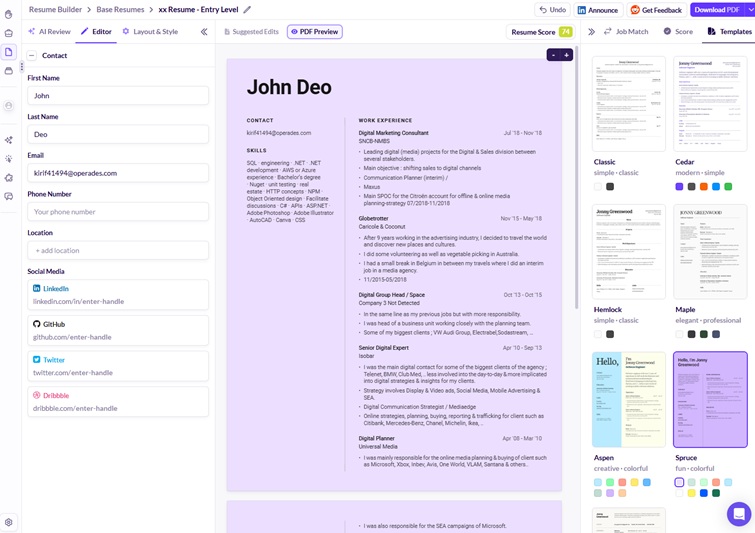
Acting Resume Examples: Format, Sections, and Filled-In Templates
Acting resume examples for every career stage. Learn the correct format, what casting directors want, union vs. non-unio...
Read More
Musician Resume Examples: Teacher, Performer, Session, and Orchestral
Musician resume examples for every career path: music teacher, touring performer, session musician, and orchestral audit...
Read More
Graphic Designer Resume Examples: Templates for Every Specialization 2026
Six ATS-safe graphic designer resume examples with business impact metrics, AI tool skills, and portfolio strategy. Bran...
Read More