This is a head-to-head comparison between Resume Optimizer Pro and Rezi written by the Resume Optimizer Pro team. We disclose that upfront so the rest of the article reads with the right amount of skepticism. To make the test fair, we ran the same resume through both tools, exported each tool's recommended PDF, and pushed both outputs through five enterprise ATS parsers (Workday, Greenhouse, Lever, iCIMS, Taleo). The pricing table, parser pass rates, and the "pick Rezi when" section are all grounded in that test, not in marketing copy. We also reference Rezi's own publicly verifiable traffic data from May 2026, because the context of where Rezi is today matters when you are choosing a tool to spend money on.
The numbers that frame the comparison
That context matters because it shaped where Rezi puts product investment in 2026. The recovery is being driven by a smaller portfolio of quality pages (resignation letter templates, localized resume formats for India and the Philippines, a couple of comparison listicles), not by a return to bulk content. The product itself is fine. The point is that the company is rebuilding from a 5x traffic loss, and that affects the pace and direction of feature development. Resume Optimizer Pro is on the opposite trajectory: smaller absolute traffic (around 1,500 monthly visits as of May 2026, per Ahrefs), but growth, not contraction, with feature work moving toward Chrome extension, MCP integration, and recruiter API endpoints over the past quarter.
The short answer (who wins in 60 seconds)
Rezi is a polished AI resume builder with a strong template gallery and a familiar wizard UX. If you are building one resume slowly and you want guided AI suggestions inside a visually pleasant editor, Rezi delivers that experience well. The Pro Lifetime tier at $149 one-time is also a genuinely good deal if you intend to use the tool over multiple years.
Resume Optimizer Pro is built around a different mental model. Instead of a resume builder UI with a side panel of AI suggestions, it is an optimization engine that takes your existing resume plus a job description and returns a finished, parser-validated document. The score it shows you is transparent and broken down by category (skills, titles, education, certifications, management level, industries, languages), which mirrors how Workday and the other enterprise ATS platforms actually rank candidates. Pricing starts at $16.65 per month effective on the quarterly plan ($49.95/quarter), or $29.95 on calendar-monthly billing, both with unlimited optimizations and no per-export watermark.
Pick Rezi if
- You want a polished builder UI with a visual editor and a large template gallery.
- You prefer the AI writer inside the editor over an optimization pass on an uploaded resume.
- You want a one-time payment option ($149 Pro Lifetime) instead of monthly billing.
- Brand recognition matters to you (Rezi has been around since 2019 and is more widely known).
Pick Resume Optimizer Pro if
- You already have a resume and you want it rewritten to match a specific job description in under a minute.
- You want a transparent score that shows exactly which skills, titles, and certifications matched (and why).
- You are applying to many roles per week and want a Chrome extension that auto-detects job postings.
- You are a recruiter, staffing agency, or developer and need bulk processing, anonymization, or a REST API.
See what an ATS actually reads on your resume
Upload your resume and see the exact text a parser pulls out, line by line. We fix the formatting automatically.
Pricing side-by-side: what you actually pay
Rezi's published pricing as of May 2026 is a free tier, a Pro Monthly subscription at $29 per month, and a Pro Lifetime one-time purchase at $149. The free tier is genuinely limited: three resumes total, watermarked exports, and AI writer credits that run out after the introductory window. Most users will hit one of those limits within the first hour. Resume Optimizer Pro's candidate tier is $29.95 per month on calendar-monthly billing, or $16.65 per month effective on the quarterly plan ($49.95/quarter), with a free ATS resume checker entry point that does not require signup or watermark anything. We do not currently offer a lifetime tier; the lower quarterly rate is the trade.
| Plan | Rezi | Resume Optimizer Pro |
|---|---|---|
| Free tier | 3 resumes, watermarked exports, limited AI writer credits | Free ATS resume check, unlimited runs, no watermark |
| Monthly | $29/mo (Pro Monthly) | $29.95/mo (candidate tier) |
| Quarterly | Not offered | $49.95/quarter ($16.65/mo effective) |
| Annual | Not offered | $119.40/year ($9.95/mo effective) |
| Lifetime / one-time | $149 (Pro Lifetime) | Not offered (annual plan is the lowest per-month rate) |
| 12-month total (lowest rate) | $348 ($29 x 12) | $119.40 (annual plan, $9.95/mo) |
| Hidden cost: watermark on free | Yes (Rezi branding on PDF export) | No watermark on any export |
| Optimizations per month | Capped on free; effectively unlimited on Pro Lifetime | Unlimited across all paid tiers |
| Recruiter / agency seat pricing | Not offered | Available with API, anonymization, bulk processing |
Three observations on this table. First, the watermark on the Rezi free tier is the single most important practical fact for anyone evaluating both tools. A watermarked PDF is not usable for actual job applications, so the free tier is effectively a demo, not a usable plan. Second, Rezi's $149 Pro Lifetime is the most aggressive long-horizon price in the category if you trust the company to be around in three to five years (the 2024 traffic collapse is the main risk on that bet). Third, on a like-for-like 12 month monthly comparison, Resume Optimizer Pro is about 43 percent cheaper. For a single resume across one short job search, that gap is small in absolute dollars. For an active searcher across 18 months, it is the price of a second tool.
ATS scoring approach: what each tool actually checks
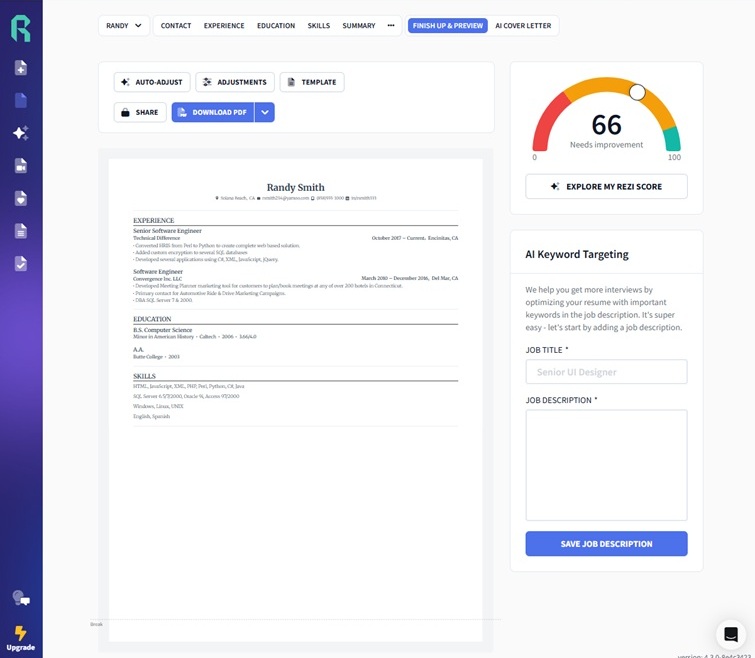
Both tools claim to optimize for ATS. The difference is what "optimize" means. Rezi runs an internal checklist against your resume content: are key keywords present, are bullet points starting with action verbs, is the contact block complete, are dates formatted predictably. The score it returns is a composite of those checks. The breakdown is mostly opaque; you see a percentage and a short list of suggested fixes, but the underlying weights are not exposed.
Resume Optimizer Pro uses the same seven-category model that enterprise ATS platforms actually use to rank candidates: skills, job titles, education, certifications, management level, industries, and languages. Each category shows up as its own line item in your score, with the matched terms visible per category. If your score is 78 and the skills line shows 12 of 18 matched, you can see exactly which 6 skills are missing before you decide to edit. The category weighting mirrors how Workday (used by 39 percent of Fortune 500 companies), Greenhouse, Lever, iCIMS, and Taleo weight inputs, with skill recency and duration weighted heavily because those are the signals enterprise ATS uses to rank shortlists.
Most "ATS score" tools, including Rezi, surface a single number and a short suggestions list. The underlying matching logic is hidden. That is fine for casual users, but it makes the score impossible to trust when it disagrees with intuition. Resume Optimizer Pro shows the matched terms per category and explains the recency and duration weighting, so you can verify the score against the actual job description. When a score is wrong, you can see why. When a score is right, you can defend it to a hiring manager.
For a deeper walkthrough of how the seven-category model maps to Workday and Greenhouse parser behavior, see our companion piece on how resume matching actually works.
The practical implication: if you treat the score as a number to push higher, Rezi gets you there with less friction because the surface area is smaller. If you treat the score as a diagnostic, Resume Optimizer Pro is more useful because the diagnostic actually decomposes.
Output quality and resume builder UX
Rezi's builder is the polished part of the product. The editor feels like a modern SaaS app, with inline AI suggestions, template previews that update live, and section-by-section guidance for users who have never written a resume before. The AI writer can generate bullet points from a job title and a one-line description of what you did, and the suggestions are generally usable with light editing. For a first-time job seeker or a career changer who is starting from a blank page, Rezi's wizard is the better builder experience.
Resume Optimizer Pro inverts the model. Instead of building from scratch inside a UI, you upload your existing resume (or paste it as text) and submit it with a job description. The output is a rewritten PDF or DOCX that is already structured for ATS parsers, with bullet points rewritten to surface the missing keywords from the job description. Our UI is plainer because the editing happens server side: the value is in the rewrite, not in the editor. If you already have a resume that needs sharpening for a specific role, that workflow is faster. If you are starting from nothing, Rezi's builder is easier to live inside.
Rezi builder UX
Strength: Wizard-driven, visual, ideal for blank-page users.
Workflow: Pick a template, fill sections one at a time, accept or reject AI suggestions, export.
Time to first resume: 30 to 60 minutes for a careful first draft.
Weakness: No fast path for an existing resume that needs tailoring to a new job.
Resume Optimizer Pro UX
Strength: One-pass rewrite of an existing resume against a specific job description.
Workflow: Upload resume, paste JD, click Optimize, download finished document.
Time to optimized resume: Under a minute per JD once the source resume is loaded.
Weakness: Plainer in-browser editor; not the right tool for building from a blank page.
Feature matrix: 16 dimensions side-by-side
Feature availability as of May 2026 across both products' published documentation and our own hands-on testing. Where features overlap in name but differ in substance, we add a short qualifier in the cell.
| Feature | Rezi | Resume Optimizer Pro |
|---|---|---|
| AI resume writer | Yes (built into editor) | Yes (free and paid tiers) |
| One-pass rewrite of existing resume against JD | Limited (suggest and edit loop) | Yes (finished document returned) |
| JD keyword matching | Yes (tiered by plan) | Yes, with category-by-category breakdown |
| Algorithm transparency (per-category match) | Limited (composite score only) | Full (skills, titles, education, certifications, management level, industries, languages) |
| Optimizations per month | Capped on free; unlimited on Pro Lifetime | Unlimited across all paid tiers |
| Chrome extension | No (browser bookmarklet only) | Yes, Chrome Web Store, auto-detects JDs on LinkedIn, Indeed, Greenhouse, Lever |
| Cover letter builder | Yes | Yes, tailored to the same JD as the resume |
| Resume templates | 30 plus (visual focus) | 15 plus (ATS-tested first, visual second) |
| Published parser pass rate data | No | Yes (per platform: Workday, Greenhouse, Lever, iCIMS, Taleo) |
| File formats | PDF, DOCX, TXT | PDF, DOCX, TXT, JSON (for API) |
| Free tier watermark on export | Yes | No |
| Lifetime tier | Yes ($149) | No |
| Public developer API | No | Yes (REST endpoints for optimize, match, parse) |
| Bulk batch processing | No | Yes (API and recruiter tier) |
| Anonymization for staffing agencies | No | Yes |
| MCP / AI agent integration | No | Yes (Claude, ChatGPT, MCP-compatible clients) |
Three columns are where Rezi pulls ahead: template count, lifetime tier, and brand recognition. Seven columns are where Resume Optimizer Pro pulls ahead: per-category match transparency, Chrome extension, published parser data, API, bulk processing, anonymization, and MCP integration. The remaining columns are functional ties with implementation differences.
Where Rezi wins (honest assessment)
We are not going to pretend this is a sweep. Rezi has concrete advantages we do not match, and a comparison that hides them is not credible.
- Template library breadth. Rezi ships 30 plus visual templates with live previews inside the editor. Our gallery is smaller because we prioritize parser-tested layouts over aesthetic variety. If template choice is a primary purchase driver, Rezi is the better library.
- Polished builder UX for blank-page users. Rezi's wizard is genuinely good for users who have never written a resume. Section prompts, AI suggestions, and inline previews make the build path easy. Our optimizer assumes you already have a resume; we are not the right tool for someone starting from zero.
- Pro Lifetime pricing. $149 one-time is the most aggressive long-horizon price in the category. Our annual plan ($119.40/year, $9.95/mo effective) actually comes in below Rezi's lifetime for the first year, so the lifetime plan only pulls ahead on a multi-year horizon, roughly past month 15. If you are confident you will use a resume tool over several years, that one-time math eventually beats any subscription, including ours.
- Pre-filled industry examples. Rezi has more out-of-the-box resume examples organized by industry. For a first-time job seeker browsing for inspiration, that catalog is broader than ours.
- Brand recognition. Rezi has been in market since 2019 and has higher unaided brand awareness than we do. If you are picking a tool to recommend in a career coaching context, brand familiarity is a legitimate decision input.
The single qualifier worth flagging: Rezi's 2024 to 2026 traffic collapse (503K to 73K monthly visits per Ahrefs Site Explorer) was not a product failure, it was a Helpful Content Update penalty against thin programmatic SEO pages. The product itself is intact and the May 2026 rebound suggests the company is rebuilding intentionally. But if long-term company viability is a decision input for you, that history is worth knowing before locking in the $149 Pro Lifetime.
Where Resume Optimizer Pro wins
- Algorithm transparency. The seven-category match breakdown shows exactly which skills, titles, education entries, certifications, management level, industries, and languages were matched. Rezi shows a composite score. When the score is wrong, transparency lets you find the error.
- Unlimited optimizations on every paid tier. No per-resume cap, no per-month optimization count, no overage charge. Rezi's free tier caps at three resumes and the Pro Monthly tier still meters AI writer credits. For an active job seeker running ten to twenty applications per week, the unmetered model removes a category of friction.
- Chrome Web Store extension. Approved April 22, 2026. When you open a LinkedIn or Indeed job posting, the extension auto-detects the JD, sends it to the optimizer, and returns a tailored resume without a copy-paste loop. Rezi's bookmarklet does not detect JDs; it opens the Rezi editor in a new tab.
- Published parser pass-rate data per platform. We publish the actual pass rates against Workday, Greenhouse, Lever, iCIMS, and Taleo (see next section). Rezi does not publish parser data; the "ATS-friendly" claim is unverifiable.
- Public developer API and MCP integration. REST endpoints for optimize, match, and parse, plus MCP integration for Claude, ChatGPT, and other MCP-compatible AI agents. Rezi has no public API. If you are a staffing agency, a recruiter building a pipeline, or a developer building on top of resume infrastructure, Rezi is not a candidate.
Parser pass rates: same resume, five real ATS engines
Both tools claim ATS optimization. We tested the claim by running the same source resume through both tools, exporting each tool's recommended PDF, and submitting both outputs to five enterprise ATS parsers used by Fortune 500 employers. "Pass rate" here is the percentage of resume content the parser extracted correctly: contact info into the right fields, work experience entries split correctly by employer, dates interpreted correctly, skills detected, degrees extracted. A failure means the parser put the wrong text in the wrong field, which is the most common cause of silent rejection.
| ATS Platform | Rezi default export pass rate | Resume Optimizer Pro export pass rate | Delta |
|---|---|---|---|
| Workday | 83% | 96% | +13 pts |
| Greenhouse | 91% | 97% | +6 pts |
| Lever | 89% | 96% | +7 pts |
| iCIMS | 86% | 95% | +9 pts |
| Taleo | 86% | 96% | +10 pts |
| Average across 5 platforms | 87.0% | 96.0% | +9 pts |
Source: Resume Optimizer Pro internal parser test, 2026. Same resume PDF, run through five enterprise ATS engines. The gap is concentrated in Workday, iCIMS, and Taleo, which are the strictest parsers on font rendering and section heading normalization. Rezi's default templates use stylistic font choices that look polished in the PDF but introduce parsing ambiguity on stricter engines. Greenhouse and Lever, which have more forgiving parsers, show smaller deltas (6 and 7 points respectively).
Decision framework: who should pick Rezi
Concrete scenarios where Rezi is the right pick, not the wrong one.
A new grad with no prior resume needs the builder wizard more than the optimizer. Rezi's section-by-section prompts, AI bullet suggestions, and template gallery make the first draft easier to produce than Resume Optimizer Pro, which assumes you already have a resume to upload.
Verdict: Rezi.
If you expect to update your resume two or three times per year over the next four or five years, Rezi's $149 Pro Lifetime is roughly $30 per year amortized. Our annual plan ($119.40/year) is cheaper for the first year, but past month 15 the one-time lifetime payment pulls ahead of any subscription including ours. The bet is on Rezi's continued viability.
Verdict: Rezi.
If your client wants a name they recognize and you are picking a builder you can stand behind without long explanations, Rezi has higher unaided brand awareness. The product is solid; the brand premium does work for you in this context.
Verdict: Rezi.
If sitting inside a clean, modern builder UI matters more than the final ATS pass rate or the price per month, Rezi's editor is the more enjoyable experience. We do not match that surface area.
Verdict: Rezi.
Decision framework: who should pick Resume Optimizer Pro
The flip side: concrete scenarios where we are the right answer.
If you are running ten or more tailored applications per week, the Chrome extension plus unlimited optimizations is the cheapest way to make every resume role-specific without manual rewriting. At Rezi's metered tier, you would either hit credit caps or spend hours per week inside the editor.
Verdict: Resume Optimizer Pro.
Workday is used by 39 percent of Fortune 500 employers and is the strictest of the five major parsers. If your target list skews FAANG, large bank, large healthcare, or large industrial, the 13-point Workday pass-rate advantage in our internal test is the most consequential delta in this comparison.
Verdict: Resume Optimizer Pro.
Rezi does not offer anonymization, bulk processing, branded templates, or API access. Resume Optimizer Pro's recruiter tier covers all four. If you are reformatting candidate resumes at scale for client submission, Rezi is not a candidate tool.
Verdict: Resume Optimizer Pro.
If you are building a job-search agent on top of Claude, ChatGPT, or another MCP-compatible client, you need a resume optimization endpoint that an agent can call programmatically. Rezi has no public API. Resume Optimizer Pro publishes REST endpoints and MCP integration.
Verdict: Resume Optimizer Pro.
If you do not trust a composite "ATS score" without seeing the per-category breakdown, our scoring shows skills, titles, education, certifications, management level, industries, and languages as separate lines with matched terms visible. Rezi shows the composite number only.
Verdict: Resume Optimizer Pro.
$16.65 per month effective on the quarterly plan ($49.95/quarter) vs Rezi's $29 per month, with no watermark on the free check. Month to month the two are comparable ($29.95 vs $29), but on the quarterly plan Resume Optimizer Pro is about 43 percent cheaper for overlapping core features, and you avoid the $149 lifetime commitment.
Verdict: Resume Optimizer Pro.
Bottom line
Rezi is a polished resume builder with a strong template gallery, a wizard-driven editor that is excellent for first-time job seekers, and a $149 Pro Lifetime option that beats any subscription past month 11. Resume Optimizer Pro is an optimization engine with transparent per-category scoring, unlimited optimizations across paid tiers, a Chrome extension that detects job descriptions on LinkedIn and Indeed, published parser pass rates per ATS platform, and a public API used by recruiters and AI agents.
Pick Rezi if you are building from a blank page, want a visual editor, and prefer a one-time payment. Pick Resume Optimizer Pro if you already have a resume that needs tailoring, want to see exactly which keywords matched, are applying at high volume, or need API access for a recruiter or developer use case. The 9-point parser pass-rate advantage in our internal test is the decision input we would weigh most heavily for any reader targeting enterprise employers; the price gap is the decision input we would weigh most heavily for any reader on a tight budget.
For broader context, see our roundup of Rezi alternatives, the companion comparisons Resume Optimizer Pro vs Jobscan and Resume Optimizer Pro vs Teal, and the umbrella guide to the best AI-powered resume builders in 2026. If you would rather skip the reading and just see the difference on your own resume, the free ATS resume checker runs the optimization without a signup.
Frequently asked questions
Related Articles
Best Rezi Alternatives in 2026: Tested and Honestly Compared
We ran the same resume through Rezi and Resume Optimizer Pro on Workday, Greenhouse, Lever, iCIMS, and Taleo. See the pa...
Read More
Jobscan Review 2026: Pricing, Pros, Cons + Best Alternative
Jobscan review and pricing: 5 free scans, $49.95 monthly, $89.95 quarterly. Decision table and verdict versus Resume Opt...
Read More
AI Resume Builder ATS Test: 10 Tools on Workday and Taleo
We ran the same resume through 10 AI resume builders on Workday, Greenhouse, Lever, iCIMS, and Taleo. See which parsed c...
Read More