Most resume example directories are catalogs. They hand you 500 alphabetized PDFs and tell you to pick one. That approach breaks in 2026 because the examples were designed for visual appeal, not ATS parsing, and because picking a resume example without knowing which experience level and which industry you're targeting produces generic results. This directory is different. Every one of the 65+ filled resume examples we link to was built from a 2026 job description in that specific role and parse-tested against the Workday, Greenhouse, and Lever applicant tracking systems that filter most corporate hiring. Pick by experience level first, industry second, exact job title third, and you'll land on an example written for the decision you're actually making.
Why this directory exists
Three facts changed how resume examples should be organized in 2026.
If your resume example is decorative, it fails the first filter. If it isn't tailored to the specific role you're applying to, it fails the second. If it doesn't lead with skills and quantified outcomes, it fails the third. The examples in this directory are built to pass all three.
How to use this directory
Work through three filters in order.
The 3-filter decision
- Experience level first. Entry-level, mid-career, senior, or executive. The tone, length, and bullet density differ sharply. An entry-level resume that reads like a VP resume signals inexperience; a senior resume that reads like an entry-level resume signals lack of impact.
- Industry second. Tech, healthcare, trades, finance, and marketing use different keyword stacks. Use the industry filter to narrow the pool.
- Exact job title third. Pick the example whose title matches the job posting's title, then adapt. Don't copy bullets; adapt them with your own metrics.
Most readers skip straight to the job title. If you do, you miss the experience-level calibration, and you'll end up with an example that's either too thin or too dense for your career stage.
Filter 1: Pick by experience level
Entry-level / student (0 to 2 years)
Keep to one page. Lead with skills and education. Projects, internships, coursework count as experience.
Mid-career (3 to 8 years)
One to two pages. Lead with measurable impact. Quantify every bullet with a number, percentage, or dollar figure.
- Browse by role in sections below
- Most candidates live here
- Aim for 12 to 18 bullets total across recent roles
Senior (8 to 15 years)
Two pages. Lead with team size, scope, and business outcomes. Include mentorship, strategy, cross-functional leadership.
Executive / C-suite (15+ years)
Two to three pages. Board-level impact. Revenue, EBITDA, organization size, fundraising, exit outcomes.
Filter 2: Pick by industry
Sales, marketing & HR
Trades & skilled labor
Hospitality, service & retail
Education
Legal & government
Real estate & other
Anatomy of a resume example that passes ATS
Every filled resume example we link to shares the same five structural choices. Competitors hide these decisions inside pretty templates. We surface them.
The 5 structural choices
- Reverse-chronological layout by default. Hybrid or functional only when there's a real reason (career change, gap year, trades). Workday and Greenhouse parsers handle reverse-chrono cleanly; they struggle with functional.
- Skills section above experience on a single-column, text-first layout. Icons and two-column layouts confuse parsers.
- Bullets lead with a verb, include one number. "Managed team" fails the scan; "Managed 7 engineers, shipped 4 features per quarter with 99.5% uptime" passes it.
- Role-specific ATS keywords in the first 600 characters. Parsers weight early tokens heavier. The summary and top-of-skills section are prime real estate.
- Standard section headers. "Professional Experience," "Education," "Skills," "Certifications." Creative headers like "My Journey" break parser section detection.
Before (generic template)
Experienced software developer
- Responsible for building features
- Worked on cross-functional teams
- Maintained codebase quality
- Participated in code reviews
After (ATS-tested)
Senior Software Engineer, TypeScript / Next.js
- Shipped 12 production features across a Next.js 14 app, lifting checkout conversion 8.4%
- Led a cross-functional team of 5 (2 eng, 1 PM, 1 design, 1 data), cutting release cycle from 3 weeks to 5 days
- Reduced p95 API latency from 820ms to 210ms on the search endpoint via Redis caching
- Authored 140+ code reviews per quarter; mentored 2 junior engineers to mid-level promotion
The "before" bullets are common. They survive a casual human read but fail the ATS keyword score and the recruiter's 7-second scan. The "after" bullets work on both.
How we test every example we publish
Before any resume example goes live on this site, the sample passes through three parse tests.
| Parser | What we check | Pass threshold |
|---|---|---|
| Workday | Skills Cloud canonical mapping, work history section detection, date parsing | 95%+ field recovery on upload |
| Greenhouse | Header detection, bullet-to-paragraph retention, LinkedIn import parity | Zero section loss |
| Lever | Keyword density for primary role terms, contact info parsing | Top 5 role keywords detected |
This is why our examples don't use icon-heavy, two-column, or "creative" layouts that competitors push. Those templates fail one or more of the above tests, and "creative" is exactly the signal that makes parsers drop bullets and collapse section headers.
Pick the right template format
Three formats exist. Most candidates should use reverse-chronological.
Reverse-chronological (default)
Most recent job first. Works for 85%+ of candidates. ATS-safe. Recruiters prefer it.
Use when: you have 2+ years of work history and no major career change.
Hybrid
Skills section up top, then reverse-chrono experience. Good balance for career changers.
Use when: your most recent titles don't match the job you're applying to.
Functional (rarely)
Skills-first with no chronological history. ATS-parsers struggle with this format.
Use only when: you have a 10+ year gap, or you're returning to work from a sabbatical with no recent corporate roles.
Check any resume example before you submit
Copying a resume example doesn't guarantee it will pass ATS for your specific job description. The safer workflow: adapt an example, paste in your target job description, and run the result through an ATS checker before you apply.
If you would rather start from a generated draft than a blank page, we tested eight AI resume builders on speed, ATS safety, and how much cleanup their output needs.
Frequently asked questions
Related Articles
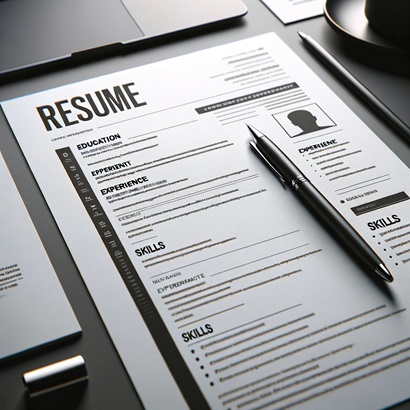
3 Resume Formats Compared: Which One Gets You Hired? (2026)
Chronological, functional, or hybrid? See ATS pass rates for each format, visual layout comparisons, and a quick decisio...
Read More
Career Change Resume: Examples, Templates, and What Actually Works in 2026
Career change resume guide with 3 complete examples, reframing formulas, ATS strategy, and the combination format struct...
Read More
How to Write a Resume in 2026: ATS Friendly Tips & Guide
Write an ATS-ready resume in 2026: pick the right format, write every section, and tailor it to the job description with...
Read More